


Why UK Punters Choose Independent Horse Racing Betting Sites
UK horse racing not on GamStop has become one of the most searched topics among British punters — and the numbers explain why. The Gambling Commission's latest industry report puts the total gross gambling yield for Great Britain at £16.8 billion for the financial year ending March 2025, a 7.3 per cent rise on the previous period. Online horse racing betting alone generated £766.7 million in GGY, making it the second-largest remote sports betting vertical behind football. That is not a niche market. It is a substantial, data-rich sector where every percentage point of odds margin matters.
At the same time, the national self-exclusion register has grown at record pace. By the end of 2025, more than 562,000 individuals had registered with GamStop, the free service that blocks access to every UKGC-licensed gambling website. For many of those people, the exclusion was a necessary reset. For others — particularly those who selected the minimum six-month period — it was a temporary pause that outlasted their intention. Either way, a growing cohort of experienced bettors now finds itself locked out of platforms like Bet365, William Hill and Ladbrokes, with no option to reverse the exclusion early.
The result is predictable: demand for offshore horse racing bookmakers that operate outside the GamStop scheme. These sites hold licences from jurisdictions such as Curaçao and Malta, accept UK customers, and are not required to check the GamStop register. They promise higher limits, bigger bonuses, and fewer restrictions. Some deliver on those promises. Others do not. This guide exists to separate the two — using regulatory data, first-hand testing, and the kind of source material that most affiliate pages never bother to read.
What follows is not a ranked list with star ratings. It is an evidence-based analysis of the non-GamStop horse racing market: how it works, what it offers, where the risks sit, and which platforms survive scrutiny. Every claim is anchored to a verifiable source. Every recommendation comes with caveats. If you are looking for hype, this is the wrong page. If you want clarity, read on.
The Numbers Behind Unrestricted Horse Racing Betting in the UK
- Online horse racing betting generates £766.7 million in annual gross gambling yield in Great Britain, making it the second-largest remote sports betting market after football.
- Over 562,000 people have registered with GamStop since 2018. Offshore bookmakers holding Curaçao or Malta licences are not connected to this database and do not check it.
- The top motivation for using non-GamStop sites is better bonuses (34.5%), not self-exclusion bypass (17.5%), according to Frontier Economics research covering 6,000+ respondents.
- Curaçao's LOK reform, in force since December 2024, replaced the old sub-licensing system with direct government licensing, KYC requirements, and mandatory dispute resolution — raising the regulatory bar for offshore operators.
- UKGC enforcement is accelerating: 384 cease-and-desist notices were issued to unlicensed operators in 2023-24, and disruption activity has increased ten-fold since April 2024.
What Is GamStop and How Does Self-Exclusion Work?
GamStop is a free, independent self-exclusion service funded by the UK gambling industry. Once registered, a person is barred from all online gambling sites licensed by the UK Gambling Commission. The block cannot be reversed before the chosen exclusion period expires.
The service launched in April 2018 and has since become one of the most widely used responsible gambling tools in Europe. By the close of 2025, cumulative registrations had passed 562,000 — equivalent to roughly 1 per cent of the UK adult population, according to GamStop's own annual report data. Those figures alone tell a story about the scale of gambling engagement in Britain and the growing demand for circuit-breaker tools.
Registration takes a few minutes. The individual enters personal details — name, date of birth, address, email — and selects one of three exclusion periods: six months, one year, or five years. There is no partial opt-out. Every UKGC-licensed operator checks new sign-ups and existing accounts against the GamStop database. If a match is found, access is denied. The scheme covers online betting, casino, bingo, and lottery sites — effectively the entire regulated remote gambling market.
The five-year period is the most frequently chosen option, accounting for 47 per cent of all registrations. In December 2024, GamStop introduced an auto-renewal feature for the five-year exclusion. Within twelve months, more than half of those selecting the maximum period had opted in to auto-renewal, indicating a preference for sustained protection rather than periodic re-evaluation.
What GamStop does not do is equally important. It does not cover land-based betting shops, casinos, or racecourse bookmakers. It does not block gambling sites that hold no UKGC licence — which is precisely where offshore horse racing bookmakers enter the picture. A site licensed solely by the Curaçao Gaming Authority or the Malta Gaming Authority has no technical connection to the GamStop database and no legal obligation to check it.
"Our data shows a significant spike in the number of younger consumers who are GAMstopping to manage their gambling, and this has driven the record registrations in 2025," said Fiona Palmer, CEO of the GamStop Group. "They are increasingly choosing six-month exclusions, which suggests that GAMSTOP is being used as a tool to allow them a break from gambling."
That shift in usage — from a last-resort lockout to a proactive management tool — has implications for the non-GamStop market. A growing number of users are experienced, self-aware bettors who chose a short exclusion, found it could not be shortened, and began exploring alternatives while the clock ran down. Understanding that context is essential before evaluating any offshore bookmaker.

Why UK Punters Seek Horse Racing Sites Outside GamStop
In April 2025, GamStop recorded 10,281 new registrations — the first time the monthly figure had ever exceeded ten thousand. May broke the record again with 10,344. Those surges did not occur in a vacuum. They coincided with a regulatory environment that has steadily tightened controls on UKGC-licensed operators: affordability checks, stake limits on online slots, and stricter identity verification. Each layer of friction, however well-intentioned, nudges a subset of users toward platforms where those rules do not apply.
A 2024 survey by Frontier Economics, commissioned by the Betting and Gaming Council and covering more than 6,000 respondents, quantified the motivations. The top five reasons people cited for using an unregulated operator were: better bonuses and free bets (34.5 per cent), ease of setting up an account (32.3 per cent), anonymity (30.9 per cent), more flexible payment options (29.6 per cent), and better odds (29.6 per cent). Further down the list: avoiding deposit limits (25.1 per cent), being able to bet more (22 per cent), and bypassing self-exclusion measures (17.5 per cent).
Those numbers deserve a moment's attention. The most popular reason is not, as commonly assumed, the desire to circumvent self-exclusion. It is the appeal of promotional offers that are structurally unavailable on UKGC platforms, where bonus rules and advertising restrictions have become markedly tighter since the 2023 gambling white paper. Non-GamStop horse racing sites routinely offer 100 to 200 per cent matched deposit bonuses, cashback deals, and free bets with lower wagering requirements than their regulated counterparts — and they market these aggressively via social media and affiliate networks.
"This shocking report exposes the unnerving true scale of the growing, unsafe, unregulated gambling black market," said Grainne Hurst, CEO of the Betting and Gaming Council, commenting on the Frontier Economics findings. "From online gaming, to betting on sports like horse racing, millions of customers are being driven into the arms of pernicious black market operators."
The non-GamStop horse racing market is driven primarily by bonus appeal and registration friction — not by self-exclusion bypass. Understanding the actual motivations helps punters evaluate whether the trade-offs are worth it for their own circumstances.
There is a broader structural factor at work, too. Online gambling's share of the total UK market has grown from 15 per cent in the financial year 2012-13 to 60 per cent by 2023-24, according to analysis by the Social Market Foundation. The digital migration makes offshore alternatives more accessible than they were even five years ago. A punter who once needed a physical betting shop can now open an offshore account from a mobile browser in under three minutes, fund it with crypto, and place a bet on the 3:30 at Cheltenham — all without encountering a single UKGC checkpoint.
None of this is a recommendation. It is a description of the landscape. The question for any individual punter is not whether these sites exist, but whether the advantages they advertise survive contact with the fine print. That requires a method, which is what the next section provides.
How We Evaluate Non-GamStop Horse Racing Bookmakers
Most non-GamStop review sites grade bookmakers on a vague scale of vibes and welcome bonuses. We use a seven-point framework that prioritises verifiable facts over subjective impressions. Every platform in this guide was tested with a real deposit, a real bet, and a real withdrawal attempt. Here is what we check, and in what order.
Licensing verification. We confirm the operator's licence status directly through the issuing authority's public register — the Curaçao Gaming Authority portal for CGA licences, or the MGA's licence check tool for Malta. If the licence number cited on the site does not match the register, the site is excluded. No exceptions.
Horse racing coverage. A site can have a stellar casino section and still be useless for racing. We check for coverage of UK and Irish fixtures, availability of ante-post markets, depth of in-play options, and whether the race card includes form data or simply lists runners and odds.
Odds competitiveness. We compare opening and closing prices on a sample of UK races against three UKGC-licensed benchmarks over a two-week period. The goal is not to find the cheapest overround on every race — that fluctuates — but to assess whether the site consistently prices within a reasonable margin or systematically undercuts the market.
Bonus terms and wagering requirements. A 200 per cent matched bonus sounds generous until the 40x rollover and sport-type restrictions are factored in. We read the full bonus terms, calculate the effective value assuming realistic turnover, and flag any conditions that make the bonus functionally unredeemable on horse racing.
Payment infrastructure. We test at least two deposit and one withdrawal method per site. Processing times, minimum withdrawal thresholds, and any fees are recorded. Particular attention goes to crypto support — speed of confirmation, accepted coins, and whether the site converts to fiat or lets bettors hold a crypto balance.
Mobile experience. Since no non-GamStop horse racing site currently offers a native app through the Apple App Store or Google Play — app store policies prevent it — we evaluate the mobile-optimised web experience. We check bet slip usability on a phone screen, live streaming stability over mobile data, and page load times on mid-range devices.
Responsible gambling tools. This is where the gap between UKGC and offshore operators becomes sharpest. We document what each site offers: deposit limits, session timers, cooling-off periods, and internal self-exclusion. We also note what is absent. If a site has no responsible gambling page at all, it does not make this list.
Top-Rated Horse Racing Sites Not on GamStop: 2026 Overview
The following five platforms passed all seven of our review criteria. Each holds a verifiable offshore licence, offers genuine horse racing markets on UK and international fixtures, and provides at least basic responsible gambling tools. They are listed alphabetically — not ranked — because the best choice depends on what matters most to the individual bettor: odds depth, bonus value, crypto support, or live streaming quality.
CosmoBet
Licence: Curaçao (CGA) | Welcome bonus: 150% up to €1,000 | Min. deposit: €20 | Crypto: Yes (BTC, ETH, LTC, USDT) | Live streaming: Select races
CosmoBet stands out for the sheer breadth of its racing sportsbook. UK, Irish, French, South African, and Australian meetings are covered daily, with ante-post markets opening weeks before major festivals. The 150 per cent welcome bonus carries a 10x wagering requirement on sports — lower than most competitors. The live streaming feed covers a rotating selection of international fixtures, though UK coverage is inconsistent. Deposit methods include credit cards and a wide range of cryptocurrencies, with withdrawals typically processed within 24 hours for crypto and 48 hours for e-wallets.
GoldenBet
Licence: Curaçao (CGA) | Welcome bonus: 100% up to €500 | Min. deposit: €10 | Crypto: Yes | Live streaming: Yes
GoldenBet has built a reputation on reliability rather than flash. The €10 minimum deposit is the lowest on this list, making it accessible for punters testing the offshore waters with modest stakes. Horse racing coverage spans UK, Irish, and major international events. The 100 per cent bonus is straightforward, with clear terms and a reasonable rollover. The live streaming platform performs well on mobile browsers, with minimal latency on the races we tested. A 3+1 FreeBet loyalty programme rewards regular users with a free bet after every three qualifying wagers.
MyStake
Licence: Curaçao (CGA) | Welcome bonus: 100% up to €500 | Min. deposit: €20 | Crypto: Yes | Live streaming: Yes (extensive)
MyStake merits attention for two reasons: the depth of its race card data and the quality of its live streaming. Detailed form information — including recent runs, trainer stats, and jockey records — is available directly on the platform, reducing the need to cross-reference external sources. The site covers UK, Irish, US, Australian, and South African racing. Odds are competitive, regularly matching or narrowly beating the Curaçao-licensed average on UK fixtures. Greyhound racing is also available for punters who want to diversify. The welcome bonus is standard at 100 per cent, with sports wagering requirements that are achievable on racing turnover.
Rolletto
Licence: Curaçao (CGA) | Welcome bonus: 150% up to €500 | Min. deposit: €20 | Crypto: Yes | Live streaming: Select events
Rolletto impressed in our odds comparison testing. Across a two-week sample of UK flat and jump racing, its prices consistently sat in the top two among the five sites reviewed here. The 150 per cent bonus is subject to a 10x wagering requirement — generous by offshore standards. In-play betting is available on selected races, though the range of live markets is narrower than at MyStake. The site's interface is clean and fast on mobile, with a dedicated racing section that separates upcoming UK events from international fixtures.
VeloBet
Licence: Curaçao (CGA) | Welcome bonus: 100% sports bonus | Min. deposit: €20 | Crypto: Yes (wide range) | Live streaming: Yes
VeloBet positions itself as a sports-first platform, and the racing section reflects that focus. Coverage includes daily UK and Irish meetings alongside regular fixtures from France, Australia, and the Americas. The platform supports an unusually broad range of cryptocurrencies, which is relevant for punters who prefer to deposit and withdraw in USDT or similar stablecoins to avoid exchange rate volatility. The live streaming experience is solid, with race commentary available on most UK events. Responsible gambling tools include deposit limits and a cooling-off option — not industry-leading, but more than some competitors offer.
A comparison table summarising the key differentiators:
| Site | Licence | Welcome Bonus | Min. Deposit | Crypto | Live Stream | UK Racing |
|---|---|---|---|---|---|---|
| CosmoBet | Curaçao | 150% to €1,000 | €20 | Yes | Partial | Full |
| GoldenBet | Curaçao | 100% to €500 | €10 | Yes | Yes | Full |
| MyStake | Curaçao | 100% to €500 | €20 | Yes | Yes | Full |
| Rolletto | Curaçao | 150% to €500 | €20 | Yes | Partial | Full |
| VeloBet | Curaçao | 100% sports | €20 | Wide range | Yes | Full |
All five sites accept UK customers without requiring a GamStop check. All are denominated in euros rather than pounds — a common trait of offshore operations. Currency conversion fees vary; punters depositing with crypto can avoid them entirely. With the platforms established, the next step is understanding the product they are selling: the races themselves.
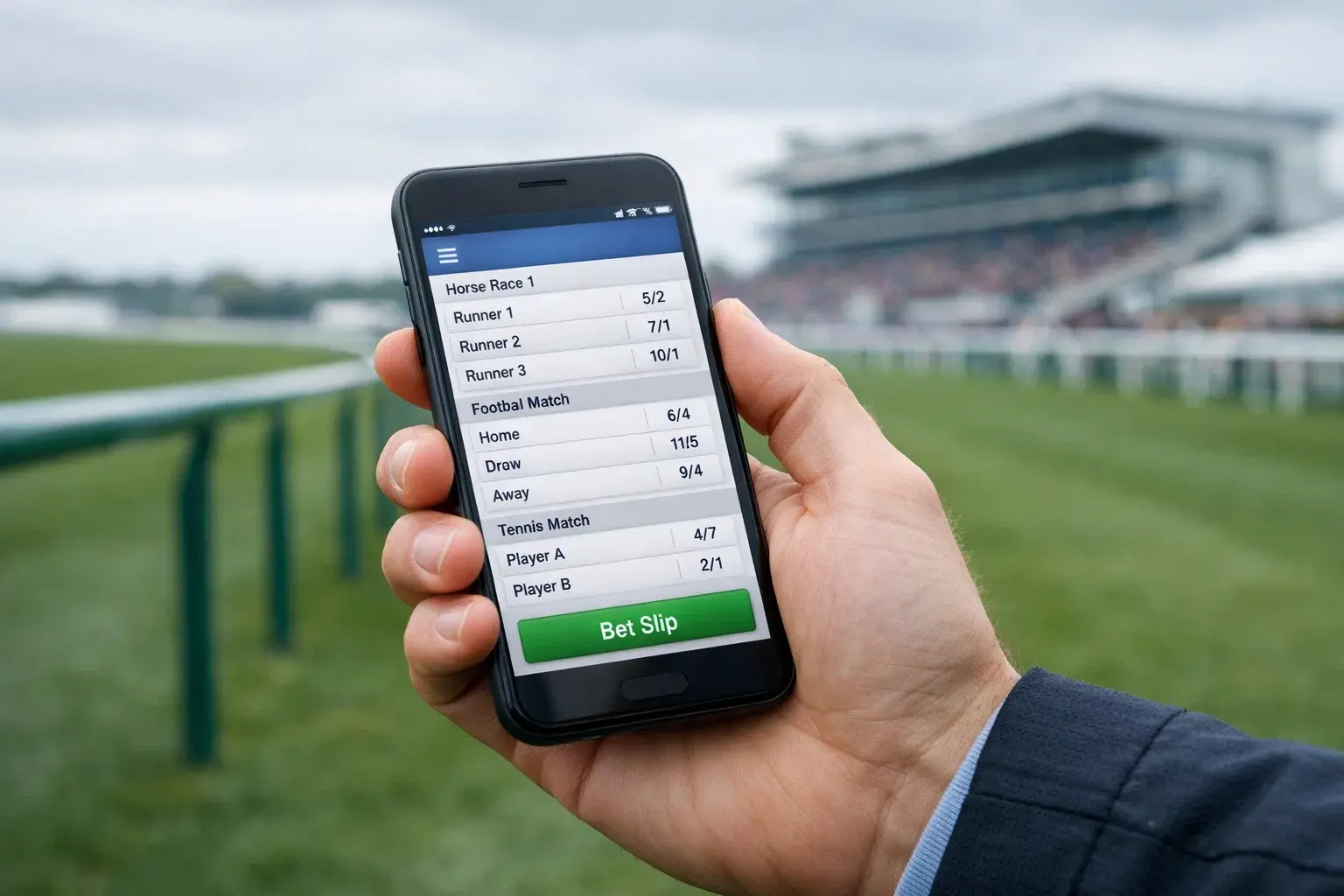
Race Types: Flat, Jump, Hurdle, and Harness Racing
The British horse racing industry generates direct revenues exceeding £1.47 billion and contributes an estimated £4.1 billion annually to the UK economy when induced effects are included, according to the British Horseracing Authority's submission to the Gambling Act review. It supports over 85,000 jobs across 59 racecourses. Understanding the sport's structure is not optional for serious bettors — it is the foundation of every informed wager.
Flat racing takes place on level courses with no obstacles. Distances range from five furlongs (about 1,000 metres) to two miles and six furlongs. The season runs primarily from April to October, with all-weather racing extending through winter on synthetic surfaces. Prestige events include the Epsom Derby, the 2000 Guineas, and Royal Ascot.
Jump racing — also called National Hunt — involves horses clearing fences or hurdles over longer distances. The season peaks between October and April, with the Cheltenham Festival and the Grand National at Aintree serving as its marquee events. Jump races subdivide into hurdle races, where the obstacles are lower and more forgiving, and steeplechases, where the fences are larger and falls are more frequent. The Grand National's 30 fences over four miles and two-and-a-half furlongs make it the most demanding steeplechase in the calendar.
Harness racing is less prominent in the UK than in France, Scandinavia, or North America, but several non-GamStop platforms include it in their international coverage. Horses trot while pulling a two-wheeled cart called a sulky. The betting dynamics differ from thoroughbred racing — field sizes are smaller, form is more predictable, and the pools tend to be thinner.
Most non-GamStop sites with horse racing coverage focus on flat and jump racing from UK and Irish tracks, supplemented by fixtures from Australia, South Africa, and the United States. Harness racing markets, when available, are typically drawn from French or Scandinavian meetings. Knowing which race type a platform covers — and which it ignores — determines whether it suits a particular betting strategy.
Bet Types Available on Non-GamStop Horse Racing Sites
The bet menu on offshore bookmakers mirrors what UKGC sites offer, with a few structural differences in each-way terms and accumulator limits. Here is what is typically available and how each bet type functions in the context of horse racing.
Win. The simplest bet: pick a horse, back it to finish first. If it wins, the payout is calculated at the quoted odds. If it does not, the stake is lost. Starting Price bets — where the odds are determined at the off rather than when the bet is placed — are less common on offshore platforms; most settle at the price taken.
Place. A bet on a horse to finish within a specified number of positions — usually the top two in fields of five to seven runners, or the top three in larger fields. Place-only bets are useful in competitive handicaps where picking the winner is genuinely difficult.
Each-way. Two bets in one: a win bet and a place bet at fractional odds (typically one-quarter or one-fifth of the win price). If the horse wins, both halves pay. If it places but does not win, only the place half returns. Non-GamStop sites set their own place terms, which can vary from race to race — always check before confirming.
Forecast. Predict the first and second horse in the correct order (straight forecast) or in any order (reverse forecast). Payouts are calculated by a computer using a formula based on the starting prices. Forecasts are available on most non-GamStop racing platforms for UK races.
Tricast. Predict the first three finishers in exact order. The potential returns are substantial — tricast dividends on competitive handicaps regularly reach three or four figures — but the hit rate is low. Available on races with eight or more runners.
Accumulator. A single bet combining selections from two or more races. All selections must win for the bet to pay. The appeal is the multiplication of odds: a four-fold accumulator with each selection at 3/1 returns 255/1. The risk is obvious — one loser and the entire bet is gone. Some offshore sites offer acca insurance, refunding the stake if one selection lets down an otherwise winning accumulator.
Ante-post. A bet placed days, weeks, or months before a race — typically on major events like the Cheltenham Gold Cup or the Derby. Ante-post odds are usually more generous because they carry more risk: if the horse is withdrawn, the stake is lost unless the bookmaker specifically offers non-runner no-bet terms.
In-play. Bets placed after the race has started. The availability and depth of in-play markets vary significantly between non-GamStop sites. Some offer live odds that update with each furlong; others suspend betting once the tape goes up. Latency between the live stream and the odds feed is an inherent limitation of offshore platforms, and punters should factor in a one-to-three-second delay when assessing in-play value.
Major UK and International Racing Events to Bet On
Horse racing's economic engine runs on a calendar of headline events that drive both attendance and betting volume. Online horse racing betting alone accounted for £766.7 million in gross gambling yield in the financial year to March 2025 — second only to football among remote sports betting verticals. In the first half of 2024, over 2.3 million people visited British racecourses, according to the Racecourse Association. The events below represent the peak of the calendar — and all are available for betting at the non-GamStop sites reviewed in this guide.
Cheltenham Festival
Four days in March, 28 races, and the most concentrated burst of jump racing quality in the world. The 2026 Festival runs from 10 to 13 March, with the Champion Hurdle, the Queen Mother Champion Chase, the Stayers' Hurdle, and the Cheltenham Gold Cup as the headline contests. Ante-post markets on these races open months in advance, and non-GamStop bookmakers typically offer competitive early prices. The Festival generates enormous betting turnover; for many offshore platforms, it is the single highest-revenue week of the year for horse racing.
Grand National
The Aintree Grand National is the most bet-upon horse race in Britain. Up to 34 runners tackle 30 fences over four miles and two-and-a-half furlongs, producing the kind of unpredictability that attracts once-a-year punters alongside seasoned handicappers. The race's cultural reach extends far beyond the racing community — and so does its impact on self-exclusion registrations. The Monday after the 2025 Grand National saw 437 people register with GamStop, the busiest single day in the scheme's history. That statistic encapsulates the emotional intensity the race generates.

Royal Ascot
Five days of flat racing in June, attended by the Royal Family and watched by millions on television. The meeting features Group 1 contests including the Queen Anne Stakes, the Gold Cup, and the Diamond Jubilee Stakes. Offshore bookmakers cover all Royal Ascot races, though enhanced odds promotions tend to be less generous than those offered by UKGC sites for this particular event.
Epsom Derby
The Derby — the Blue Riband of the turf — takes place on the first Saturday in June. It is a mile-and-a-half test for three-year-old colts on Epsom's unique camber, and it has a history stretching back to 1780. Ante-post markets for the Derby open after the previous season's two-year-old racing concludes, giving punters months of price movement to analyse. Non-GamStop sites typically offer full win, forecast, and tricast markets on the race.
Goodwood Festival
Held at the picturesque Goodwood racecourse in West Sussex, the five-day "Glorious Goodwood" meeting in late July or early August features a mix of Group races and competitive handicaps. The prize pool exceeds £5 million. For bettors, the large-field handicaps at Goodwood offer some of the best each-way value on the flat calendar.
International Events
The non-GamStop market's international reach is one of its structural advantages. The Kentucky Derby (first Saturday in May), the Dubai World Cup (March), the Melbourne Cup (first Tuesday in November), and the Prix de l'Arc de Triomphe (first Sunday in October) are all covered by the platforms in this guide. For punters who follow global racing form, the ability to bet on meetings across multiple time zones — often with live streaming — is a genuine differentiator that domestic-only UKGC platforms rarely match.
Licensing, Legality, and What Curaçao's LOK Reform Means
The licensing question sits at the core of every conversation about non-GamStop betting. Here is the legal architecture, stripped of marketing gloss.
The UK Gambling Commission requires any operator serving British customers to hold a UKGC licence. Operators that accept UK players without one are, by the Commission's definition, operating unlawfully in the UK market. However — and this is the distinction that matters — using an unlicensed site is not a criminal offence for the individual bettor. There is no law in England, Scotland, or Wales that penalises a consumer for placing a bet with an offshore bookmaker. The legal risk falls on the operator, not the punter.
That said, the UKGC has significantly increased its enforcement activity against unlicensed operators. In the 2023-24 financial year, the Commission issued 384 cease-and-desist notices and achieved the blocking or suspension of 136 websites. Since April 2024, the Commission has reported a ten-fold increase in disruption activity, targeting sites that specifically advertise to self-excluded consumers.
Meanwhile, approximately 5 per cent of all online gambling in the UK now takes place on unlicensed sites, up from 3.3 per cent in 2021, according to the Frontier Economics report for the BGC. That figure encompasses everything from rogue operations with no licence at all to offshore bookmakers holding legitimate Curaçao or Malta licences. Conflating the two is a common error — and a dangerous one.
The Curaçao Reform: LOK in Force Since December 2024
On 17 December 2024, the Curaçao Parliament approved the National Ordinance on Games of Chance, known as LOK. It entered into force on 24 December 2024, replacing the decades-old NOOGH framework. This is the single most important regulatory development for the non-GamStop market in years, and virtually none of the competing review sites mention it.
Under the old system, four master licence holders could issue sub-licences to an effectively unlimited number of operators, with minimal oversight. A single master licence cost relatively little; the sub-licensees paid the master holder, not the government. The result was a regulatory environment with reputation problems: weak anti-money-laundering controls, no standardised dispute resolution, and limited accountability for consumer-facing operators.
LOK changes the structure fundamentally. All licences are now issued directly by the Curaçao Gaming Authority. The annual fee for a B2C licence is approximately €47,000. Operators must implement KYC procedures, AML compliance, and alternative dispute resolution mechanisms. Physical presence on the island — a local office and three key personnel — becomes mandatory by 2028-29. By the end of 2024, the CGA had issued 220 licences under the new framework, with a further 553 applications in the queue.
Important: A Curaçao licence issued under the old NOOGH sub-licensing system is not equivalent to a LOK-era licence. Punters should verify that any site they use holds a current, CGA-issued licence by checking the official CGA portal. If the licence is not listed, treat the site with extreme caution.
The Lancet Public Health Commission on Gambling, published in October 2024, framed the broader context bluntly: "Gambling poses a threat to public health, the control of which requires a substantial expansion and tightening of gambling industry regulation." That conclusion applies to regulated and unregulated markets alike — but the practical implication for punters is that offshore licensing standards are rising, and sites that fail to keep pace will eventually lose access to payment processors, affiliate networks, and the public register that confers legitimacy.

Bonuses, Free Bets, and Promotions Worth Claiming
Promotional offers are the single biggest draw of non-GamStop horse racing sites — 34.5 per cent of users in the Frontier Economics survey cited bonuses as their primary motivation. The offers are genuinely larger than what UKGC-regulated bookmakers can legally provide, but size alone does not equal value. The details matter more than the headline.
Welcome Bonuses
Most non-GamStop racing sites offer a matched deposit bonus of 100 to 200 per cent on the first deposit. A 150 per cent bonus on a €100 deposit delivers €150 in bonus funds, giving a total balance of €250. The catch is always the wagering requirement: the number of times the bonus amount must be staked before it can be withdrawn. Requirements range from 5x (very favourable) to 40x (functionally worthless for racing). A 10x requirement on a €150 bonus means €1,500 in qualifying bets — achievable over a few weeks of regular racing activity. A 40x requirement means €6,000, which few horse racing bettors would turn over naturally.
Free Bets
Free bet offers come in two forms: bet-and-get promotions (place a qualifying bet to receive a free bet token) and no-deposit free bets (credited on registration, no deposit required). The latter are rare in the racing vertical; when they appear, the maximum free bet value is typically €5 to €10 with strict withdrawal limits on winnings. Bet-and-get offers are more common and more useful, particularly when the qualifying bet requirement aligns with a race the punter intended to bet on anyway.
Ongoing Promotions
Cashback deals, weekly reload bonuses, and loyalty programmes extend beyond the welcome phase. GoldenBet's 3+1 FreeBet programme — one free bet after every three qualifying bets — is a straightforward example. Others offer enhanced odds on headline races, extra places on each-way bets during festivals, and accumulator insurance. The key question is always whether the promotion's terms allow it to be used on horse racing specifically, since some bonuses are restricted to casino or football markets.
A reliable rule: calculate the effective value of any bonus by dividing the bonus amount by the wagering requirement and comparing that figure to the theoretical cost of turnover at realistic average odds. If the effective value is negative — if the expected loss from churning through the wagering exceeds the bonus itself — the promotion is not worth claiming, regardless of the headline percentage.
Bonus Value Calculator
A “150% up to €1,000” headline tells you nothing until you factor in the wagering requirement. Enter the offer and see what it’s actually worth.
UK punter? Add currency conversion
Real value ≈ €75.00
- Bonus funds
- €150.00
- Total stake to unlock it
- €1,500
- Est. cost of clearing
- −€75.00
- Conversion cost
- −€0.00
- Expected real value
- €75.00
Quick rule of thumb — bonus ÷ wagering ×: €15.00 per turnover unit. Higher is better; anything under ~€10 rarely survives the turnover.
Payment Methods: Crypto, Cards, and E-Wallets
Payment flexibility is one of the structural advantages offshore bookmakers hold over UKGC-regulated platforms. Since April 2020, UKGC-licensed sites have been prohibited from accepting credit card deposits. Non-GamStop sites face no such restriction, though that freedom comes with its own risks — credit card gambling is banned in the regulated market for a reason.
Cryptocurrency
Bitcoin, Ethereum, Litecoin, and Tether are accepted at all five sites in this guide. Crypto deposits are typically confirmed within minutes, and withdrawals process faster than any fiat method — often within an hour for established accounts. The main advantage is transactional speed and privacy; the main disadvantage is volatility. A punter who deposits 0.01 BTC when Bitcoin is at £40,000 and withdraws when it has dropped to £35,000 has lost 12.5 per cent of their balance before placing a single bet. Stablecoins like USDT eliminate this risk and are increasingly supported.
Debit and Credit Cards
Visa and Mastercard deposits work much as they would on any e-commerce site. Processing is instant; withdrawals to cards take two to five business days. The acceptance of credit cards distinguishes these platforms from UKGC bookmakers, but punters should be aware that borrowing money to gamble is one of the strongest predictors of gambling-related harm. The UKGC did not introduce its credit card ban lightly.
E-Wallets
Skrill and Neteller remain the most common e-wallet options. PayPal is not available — its terms of service prohibit use at unlicensed gambling sites. E-wallet deposits are instant; withdrawals take 24 to 48 hours. Some sites charge a small percentage fee on e-wallet withdrawals; others absorb the cost. Always check the cashier page before depositing.
One consistent feature across offshore platforms: deposits are processed in euros. UK punters depositing in pounds will incur a currency conversion fee — typically 1.5 to 3 per cent, depending on the payment method and provider. For regular bettors, the cumulative impact of conversion fees is not trivial and should be factored into bankroll calculations.
Responsible Gambling: Tools, Limits, and When to Step Back
This section is not a formality. The Lancet Public Health Commission on Gambling, published in October 2024, estimated that approximately 448.7 million adults worldwide experience some level of risk gambling, with around 80 million meeting the criteria for gambling disorder. The UK is not exempt from those numbers. In the second half of 2025, people aged 16 to 24 accounted for 29 per cent of all new GamStop registrations — a 40 per cent year-on-year increase — suggesting that younger demographics are disproportionately affected.
Non-GamStop sites operate without the responsible gambling framework that the UKGC mandates for licensed operators. What they offer instead varies widely. The better platforms provide deposit limits (daily, weekly, monthly), session time reminders, cooling-off periods (24 hours to 30 days), and internal self-exclusion options that block the account for a set period. The worse platforms provide nothing beyond a link to GamCare buried in their footer.
Know the gap: UKGC-licensed operators are required to conduct affordability checks when customer activity crosses defined thresholds. No offshore bookmaker is subject to equivalent obligations. This means there is no external system intervening if spending escalates beyond what a player can afford. The responsibility falls entirely on the individual.
The data from the House of Lords Gambling Industry Committee, cited during parliamentary debates in December 2025, found that 60 per cent of the gambling industry's profits come from just 5 per cent of customers — those classified as problem gamblers or at risk. That concentration is a structural feature of the business model, not an aberration. It applies to regulated and unregulated operators alike, though the absence of UKGC intervention mechanisms on offshore sites means the safety net is thinner.
If you are using non-GamStop horse racing sites — or any gambling platform — and notice that your spending has increased, that you are chasing losses, or that betting has stopped being enjoyable, the following resources are available and free:
- GamCare: Free confidential support, live chat, and counselling. Call 0808 8020 133.
- Gamban: Software that blocks access to gambling sites across all devices, including offshore platforms that GamStop does not cover.
- TalkBanStop: A combined service linking GamCare counselling, Gamban device blocking, and GamStop self-exclusion.
- National Gambling Helpline: 0808 8020 133 — available 24 hours a day, 7 days a week.
No betting guide — including this one — is worth prioritising over your financial or mental well-being. The data in this article is designed to help you make informed decisions. It is not a licence to ignore the signals that something has gone wrong.

Frequently Asked Questions
Are horse racing sites not on GamStop legal in the UK?
Using an offshore horse racing site is not a criminal offence for a UK-based individual. The Gambling Act 2005 places licensing obligations on operators, not consumers. However, any site offering gambling services to British customers without a UKGC licence is operating unlawfully from the regulator's perspective. The practical consequence for punters is that they cannot rely on UKGC consumer protection mechanisms — including dispute mediation, fund segregation requirements, or complaints escalation — if something goes wrong. The Gambling Commission issued 384 cease-and-desist notices to unlicensed operators in 2023-24 and blocked 136 sites, demonstrating that enforcement is active and intensifying.
What are the risks of betting on horse racing without GamStop?
The primary risks are: absence of UKGC-mandated responsible gambling protections, no guarantee that customer funds are held in segregated accounts, limited recourse in payment disputes, and exposure to operators with weaker regulatory oversight. Research by the Gambling Commission published in September 2025 found that engagement with unlicensed sites is highest among men aged 18 to 24 and individuals who score 8 or more on the Problem Gambling Severity Index — the same demographic most vulnerable to gambling-related harm. Punters should verify the operator's licence through the relevant authority's public register, set personal deposit limits before betting, and use device-blocking tools like Gamban if self-control becomes difficult.
Do non-GamStop horse racing sites offer live streaming?
Several non-GamStop sites — including MyStake, VeloBet, and GoldenBet — stream live horse racing from a selection of UK and international meetings. Coverage is not as comprehensive as what Racing TV or Sky Bet provide on UKGC platforms; streams may cover international fixtures more consistently than UK races, and availability can vary by day and time. Quality is generally acceptable on desktop and mobile browsers, though a one-to-three-second latency gap between the stream and the odds feed is common. For punters who rely heavily on live racing visuals for in-play betting, the streaming limitations of offshore sites are a meaningful trade-off to consider.
